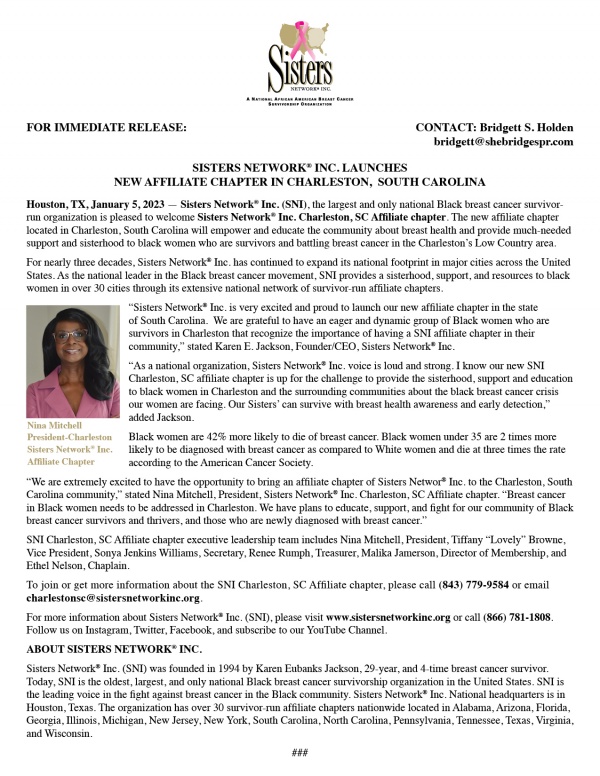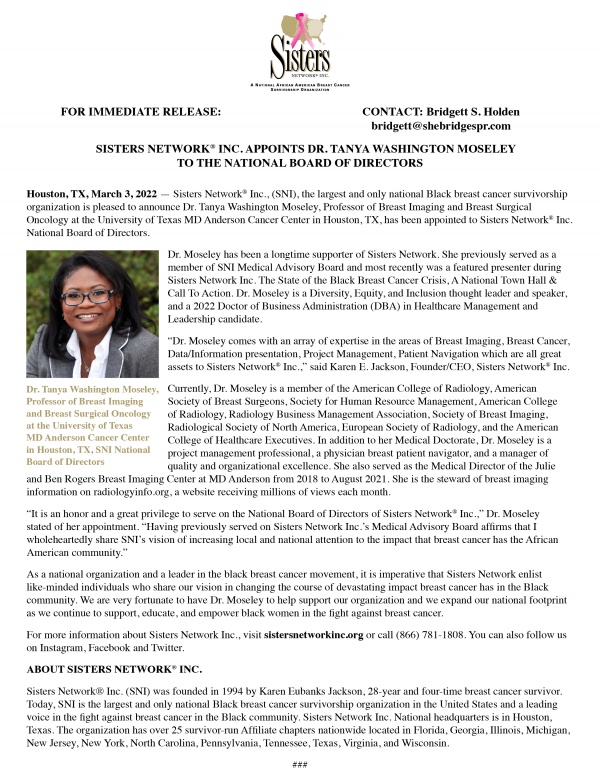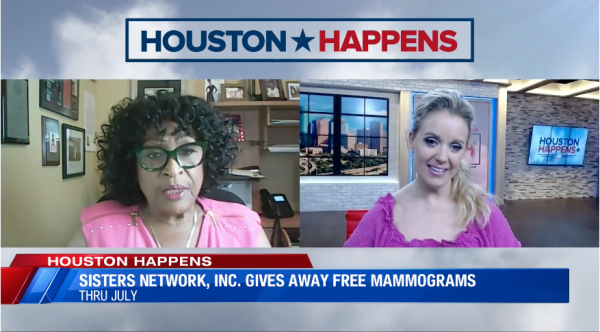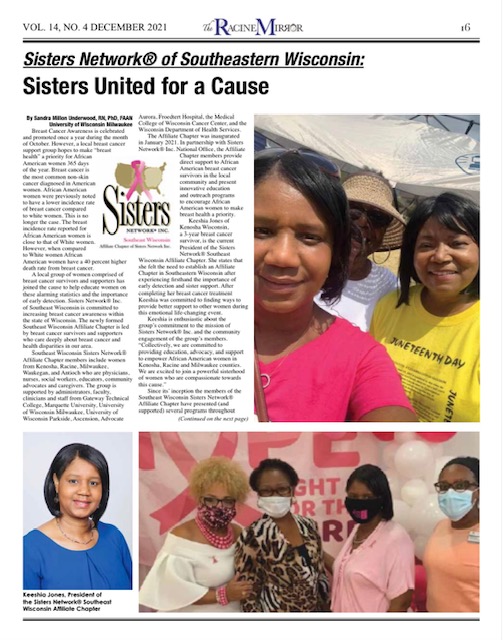








Click here to download and print media kit.
Sisters Network News Links (click links below)
Black Women Wait Too Long for Breast Cancer Testing and Treatment-Washington Post Article
Galena Biopharma Announces Expansion of Scientific Advisory
Board
Mammograms Can Save Lives for Women in their
40's
ISAPS
Official Statement on Faulty PIP and ROFIL Medro Breast Implants
Why do African American Women Have the Highest Mortality (My9 News featuring
Sisters Network Central New Jersey)
Women That Inspire-Hope for Women Magazine Article
Buddy Check 6-Gift for LIfe Block Walk-Saving Lives
Sisters Network Inc Founder/CEO "Think Pink But Buy Smart"
SNI Shreveport Chapter President in National
Magazine
Lighting of the Sister House-Houston
Forward Times Magazine
Stop The Silence: The Promise of Sisters Network
by Crystal Brown-Tatum
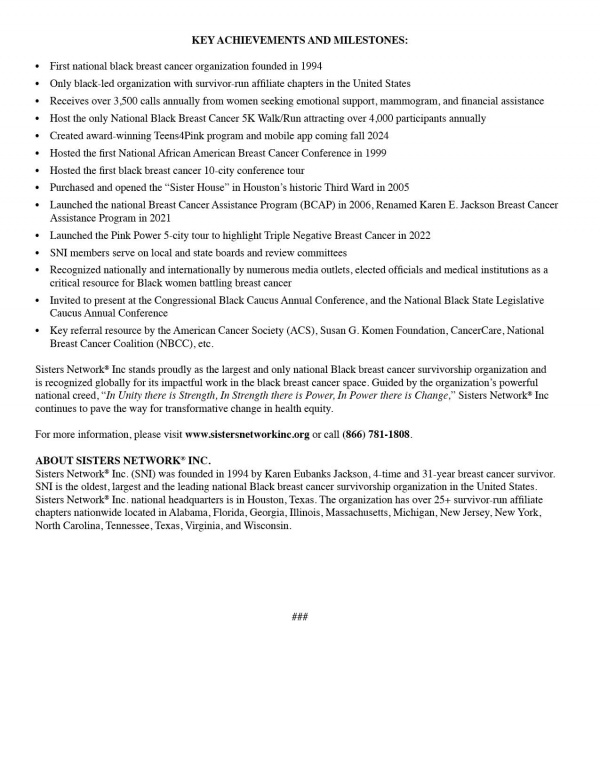
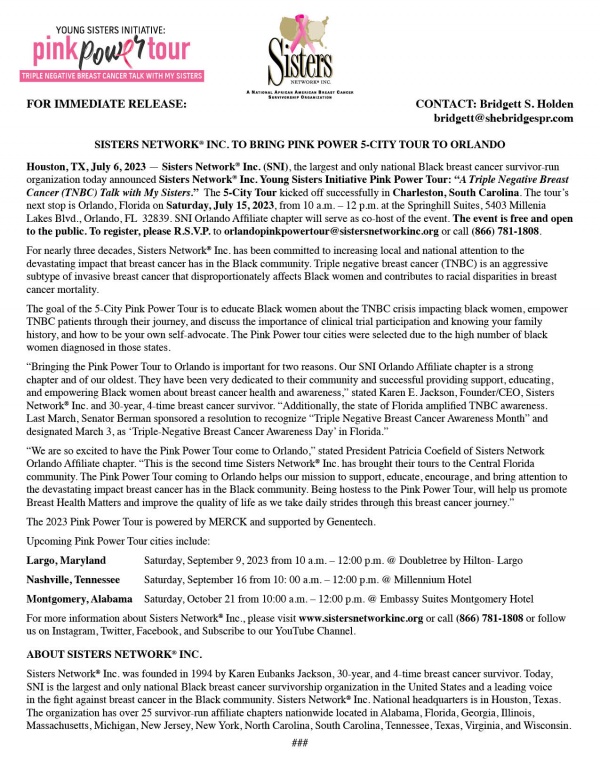
The moment Karen Jackson heard the words, “You have cancer,” she knew her life was forever changed. Diagnosed with Stage II breast cancer in 1993 and told she had five years to live, Jackson made the decision that she was going to survive the diagnosis and make a huge difference in the lives of other women who would face a breast cancer diagnosis. Her experiences and observations while undergoing treatment paved the way for Jackson to embark on a personal journey to ensure that no African-American women would have to suffer in silence endure treatment alone or even die from breast cancer because they simply lacked breast health awareness information or access to resources.
Jackson’s focused mission to increase breast health awareness in her community resulted in her founding Sisters Network Inc. (SNI), the leading voice and only national African-American Breast Cancer survivorship organization in the United States. The organization began with very little funding but plenty of grassroots advocacy as Karen and a small group of dedicated volunteers worked tirelessly spreading the breast health messages throughout Houston.
A new home, where the heart is
Seventeen years later, Sisters Network Inc. is now headquartered in a beautiful and newly acquired two-story house affectionately called “Sister House” in Houston, Texas. Sister House doubles as a patient library and a comfortable retreat for those seeking support services during treatment. The organization has 43 affiliate chapters located in 22 States and is governed by an elected Board of Directors and assisted by an appointed medical advisory committee. Various SNI chapters across the U.S. conduct community health fairs, mammography screening programs, and faith-based awareness programs.
SNI is committed to increasing local and national attention to the devastating impact that breast cancer has in the African-American community. SNI members counsel newly diagnosed women and empowers them with all the treatment options that are available. In addition to emotional support, the organization is committed to community outreach, education and encouraging more African-American to participate in clinical trials and research. SNI’s national branding campaign “Stop the Silence” addresses the African American community’s long standing history of not discussing cancer and other potentially life-threatening health concerns. Dedicated community volunteers hit the streets through local SNI affiliate chapters, and literally knock on doors talking to women about breast cancer. The Gift for Life Block Walk is a unique, innovative program that allows a personal sharing of survivor stories and the important work of distributing various breast care education materials.
Annual conference and more purposeful walking
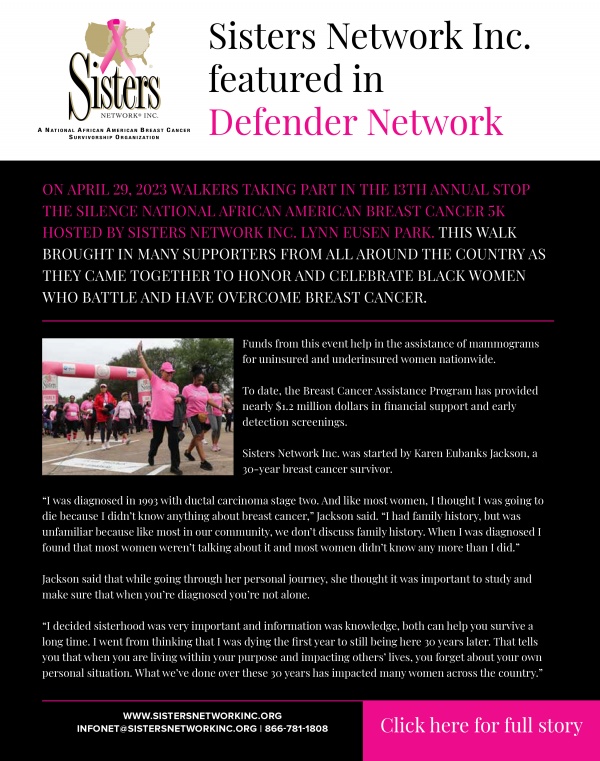
Recently SNI hosted its 11th Annual National African-American Breast Cancer Conference in Houston, Texas and kicked off the first historic National African-American Breast Cancer 5K Walk/Run. Celebrity Walk Chair was Judge Glenda Hatchett and co-chair was former Tennis Superstar Zina Garrison, who was honoring her own sister’s battle with the disease. More than 4,000 breast cancer survivors, community leaders and supporters from across the country participated in the walk to raise funds and breast cancer awareness. National sponsor Sanofi-Aventis made it possible for the organization to reach its goal. Sisters Network will host its 2nd annual 5K Walk/Run on Saturday, April 9, 2011 at the beautiful downtown Discovery Green Park in Houston.
Jackson’s unwavering commitment to Stop the Silence in the African-American community is as fresh as the day she heard those dreadful three words: “You have cancer.” Jackson is grateful for the difference Sisters Network continues to make nationwide and honored that with faith and perseverance, she’s been able to keep her promise to her Sisters.
For additional information regarding the Sisters Network, please visit www.sistersnetworkinc.org; contact the organization at 2922 Rosedale St, Houston, TX 77004; call 713-781-0255 or 866-781-1808 (713-780-8998 fax); or e-mail infonet@sistersnetworkinc.org.
Crystal Brown-Tatum is a San Antonio, Texas native and author of Saltwater Taffy and Red High Heels: My Journey through Breast Cancer (Lulu Press, 2008). She is an honors graduate of The University of Houston in Radio-Television and Founder/CEO of Crystal Clear Communications; an award-winning PR firm based in Houston (www.crystalcommunicates.com).

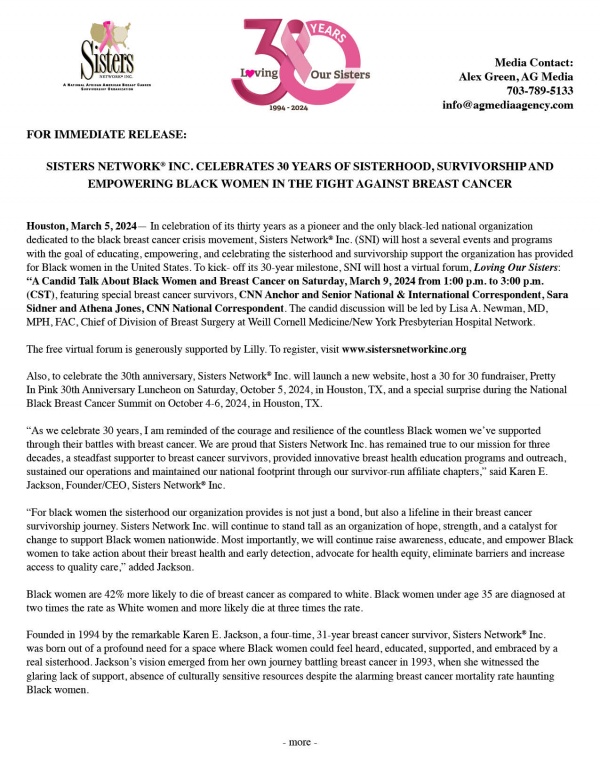
AFRICA CANCER CARE INC. HONORS SISTERS NETWORK INC. FOUNDER
Houston, Texas, December 22, 2009-- Sisters Network Inc., (SNI) the
only national African American breast cancer survivorship organization was
recently honored by the Africa Cancer Care Inc., (ACCI). The organization is
comprised of a group of individuals devoted to bridging cancer care disparties
in the United States and Africa.
Karen E. Jackson, Founder /CEO, Sisters Network was presented the 2009 ACCI Cancer Awareness award during ACCI's recent annual banquet and awards ceremony. The evening included the official diaspora launching of the International Cancer Center, Abuja. The 1st Lady of the Federal Republic of Nigeria, Her Excellency, Mrs. Turai Yar' Adua was in attendance for the special event.
Breast cancer is the most common cancer among African American women. The incidence rate of breast cancer is 12% lower in African American women; however, the mortality rate is higher compared to white women.
"Sisters Network appreciates being recognized by an important global organization such as Africa Cancer Care Inc. Sisters' understands that our breast cancer awareness efforts should not be limited to black women in the United States, our sisters in Africa also need to hear our breast health message and be educated about the importance of early detection," said Karen E. Jackson, Founder/CEO, Sisters Network Inc.
"Africa Cancer Care Inc. is looking forward to forming a partnership with Sisters Network Inc. Our organizations are both committed to working together to inspire and bring positive changes in the lives of women in Africa and the United States, " said Dr. Eucharia Iwuanyanwu, President, Africa Cancer Care Inc.

The Sisters Network: A National African American Breast Cancer Survivor
By: Lisa A. Newman, MD, MPH, and Karen E. Jackson
Two of our most powerful weapons in the battle against breast cancer
mortality are screening programs for early detection and clinical trials for
the development of improved treatments. Optimal utilization of both strategies
mandates that we work closely with survivor advocacy organizations. Survivor
advocates are powerful and trusted members of the oncology patient population,
and this is particularly true in the field of breast cancer. They serve as
ambassadors to promote mammographic surveillance in the workplace, in churches,
and through print and broadcast media. Survivor advocates have been essential
partners in breast cancer research fundraising efforts. They have provided
guidance to investigators by ensuring that issues of survivorship and quality
of life are appropriately prioritized. They have also become active in the
legislative arena as their influential voices can be heard on Capitol Hill
calling for the protection of and an increase in government funds for
research.
The oncology community is therefore extremely fortunate to partner with the
power and strength of the Sisters Network, the only national African American
breast cancer survivor advocacy organization. The mission of the Sisters
Network is based on a commitment to increasing local and national attention to
the devastating impact that breast cancer has in the African American
community. The Sisters Network was founded by Karen E. Jackson in October 1994.
Jackson is an African American woman who was diagnosed with breast cancer only
a few months earlier. Her experiences and observations while undergoing
treatment for breast cancer motivated Jackson to create an advocacy
organization dedicated to addressing the unique needs of African American
women. The scope of these needs is broad, ranging from increasing the
availability of hairpieces and mastectomy prostheses compatible with African
American appearance to increasing breast health awareness and treatment
opportunities among the general African American community. Jackson’s efforts
began with a meeting of 15 women in 1994. Today, the Sisters Network has
evolved into a national organization of nearly 3,000 members in 43 cities
throughout the United States.
“Stop the Silence” is the national slogan for the Sisters Network. This is
quite appropriate, because it acknowledges the historical inclination of many
African Americans to mistrust and avoid the medical establishment, coupled with
the socioeconomic disadvantages that promote neglect of
health care needs. Because of this neglect, even though lifetime incidence
rates of breast cancer in African American women are lower than those in white
women, the mortality rates are paradoxically higher. But with regional as well
as national outreach programs, the Sisters Network members invest their
personal resources and energies into their commitment to improving early breast
cancer detection among African American women. They also devote substantial
efforts to encouraging investigators and funding agencies to strengthen the
research agenda directed at evaluating breast cancer in African American
women.
The Sisters Network membership enthusiastically counsels new members and newly
diagnosed patients with breast cancer to empower them with all of the
prevention, early- detection, and multidisciplinary treatment options that are
available, including participation in clinical trials. The organization has
actively participated in a variety of multicenter research programs related to
breast cancer pathogenesis and survivorship. Members of the Sisters Network
serve on advisory boards for Susan G. Komen for the Cure, the National Cancer
Institute, and the American Cancer Society.
One of the many highlights of the Sisters Network activities is the annual Gift
of Life Block Walk, in which members walk door to door in neighborhoods
composed predominantly of African American residents and inform women in these
communities about breast cancer surveillance. The various Sisters Network
chapters also conduct health fairs, mammography screening programs, and
church-based breast health awareness programs. Other services focus on support
for the individual. For example, newly diagnosed African American women can
receive personalized assistance in navigating the health care system, and women
seeking baseline breast evaluation can be referred to either public mammography
screening programs or major cancer centers, depending on their needs.
The Sisters Network recently celebrated the 10th year of its annual conference
series. This national program is another high-profile aspect of the
organization’s efforts to educate the public and draw widespread attention to
the issue of breast cancer and its impact on African American women. This 3-
day conference is continuing medical education accredited and features
presentations and panel discussions by renowned
breast cancer experts. The audience includes several hundred breast cancer
survivors and advocates, legislators, health care professionals, and leaders of
community-based professional organizations. These meetings have presented
wonderful opportunities for the Sisters Network membership to partner with
public officials and local communities. The annual conference—as well as other
Sisters Network activities— has been covered by many media outlets, including
CNN, Lifetime TV, TNT, and Essence magazine.
For additional information regarding the Sisters Network, please visit
www.sistersnetworkinc.org; contact the
organization at 2922 Rosedale St, Houston, TX 77004; call 713-781-0255 or
866-781-1808 (713-780-8998 fax); or e-mail infonet@sistersnetworkinc.org.
-
Authors’ Disclosures of Potential Conflicts of
Interest
The authors indicated no potential conflicts of interest.
-
Lisa A. Newman, MD, MPH, is a surgical oncologist and associate professor of surgery and director of the Breast Care Center at the University of Michigan, Ann Arbor, MI. Contact her at lanewman@umich.edu.
Karen E. Jackson is founder and CEO of the Sisters Network, Houston, TX, and a
15-year survivor of breast cancer.
Contact her at kejackson@ sistersnetworkinc.org.

The racial bias of the breast cancer guidelines
By: Devona Walker
Source: theloop21.com
Read more about Black women and breast cancer in TheLoop21.com's series Fighting Black.
Some might think the word racist is overused and too harsh for the new breast cancer guidelines, issued by the U.S. Preventive Services Task Force. The fact is, though, the new rules that call for raising the recommended age for women to begin getting mammograms from 40 to 50 ignore the thousands of Black women who die from the disease each year. Black women, in fact, are typically diagnosed with cancer at a younger age than white women, and at a more advanced stage of the disease. The appropriate protocol for women of color would be to receive mammograms earlier not later.
When you entirely dismiss a segment of the population, and that population happens to be a racial minority — one that is at a greater risk of dying from breast cancer than any other population — what do you call it? It might not be overt racism, but these new guidelines are the very definition of institutionalized racial discrimination.
Here are some facts to consider, courtesy of Sisters Network, the Black Women's Health Imperative and the American Cancer Society:
An estimated 19,540 Black women will be diagnosed with breast cancer this year, and more than 6,000 will die.
Black women are 53 percent more likely than white women to be diagnosed at a later stage in the disease, and about 26 percent are less likely to receive radiation after breast-conserving surgery.
Black women are more than twice as likely to receive no surgery at all and 39 percent more likely to die from breast cancer.
And the worst of it is the government appears to be making the change in order to appease or shore up the bottom line of the insurance industry.
» more
Devona Walker is TheLoop21.com's senior reporter, focusing on politics and economics. She may be reached at devona@theloop21.com.

Sisters Network Inc. Founder Featured on the cover of National Breast Cancer Magazine
Houston, Texas October 22, 2009-- Karen E.
Jackson, Founder/CEO, Sisters Network Inc., a leading voice in the African
American women's fight against breast cancer was recently featured on the cover
of Breast Cancer Wellness magazine, a nationally published magazine.
In the article "Sisters Network: Making a difference to Stop the Silence,"Jackson discusses the evolution of Sisters Network since founding the organization in 1994, the importance of women putting their health first
and how Sisters Network forty three affiliate chapters nationwide remain committed to changing the African American women's breast cancer story.
Research shows black women are less likely to get breast cancer than white women, but more likely to die from it. Black women are also diagnosed more often at a younger age, and their tumors tend to be more aggressive and harder to treat. Ninety percent of white women diagnosed with breast cancer will live at least five years, but only 76% of black women will live for five years after diagnosis.
Jackson and Sisters Network Inc were also recently profiled in the Fort Bend Business Journal. In the article Jackson discusses the work of the organization and plans to open a Fort Bend area affiliate chapter to increase breast health awareness among the counties large African American population.
"The passion and committment I have for educating my Sisters' around the nation is real and unwavering. The breast cancer statistics are telling our story and that story is African American women are disportionately dying from breast cancer. Sisters Network is dedicated to changing our story to a celebration of life," says Karen E. Jackson, Founder/CEO, Sisters Network Inc.
During National Breast Cancer Awareness month, the organizations 43 affiliate chapters will be hosting the annual Gift for Life Block Walk in 19 states. During the walk, members of Sisters' local chapters take their breast cancer awareness message straight to the African American community by knocking on doors and educating women about the importance of early detection. In April 2010, Sisters Network will host, "Stop the Silence Walk" the first national African American walk. The event will be held in Houston, Texas.
"Sisters Network has accomplished so much over the last fifteen years, but there is much more work to be done. Our community must Stop the Silence, so our women can start beating the odds,' adds Jackson.
Sisters Network Inc., is the only national African American breast cancer survivorship organization. Presently, the organization has over 43 affiiate chapters nationwide. Sisters Network is recognized nationally as the leading voice in the African American women's fight against breast cancer.

Shades of A Woman CD Featuring Nationally Recognized R & B Artists To Benefit
Sisters Network Inc.
Houston, Texas
February 3, 2009-- The soothing sounds of R & B artists Will Downing, Lalah
Hathaway, Angie Stone, Wayman Tisdale, Shanice are among the featured artists
on the specially produced CD, "Shades of A Woman," benefiting Sisters Network
Inc, the first national African American breast cancer organization.
Shades is produced by mulitple Grammy nominated producer, Rex Rideout and his wife, Joi Huckaby Rideout who also served as executive producer.
"Sisters Network is providing a great service and support for African American women and families suffering from breast cancer. My family has been a victim of this devastating disease more than I can say, so I hope in some way, the CD helps to raise resources that make a difference," said Rex Rideout.
The soulful R & B compilation CD features various tracks including Angie
Stone's "More Betta," "I'm Gonna Love You Just a Little More Baby," by Will
Downing, "Looking Back," featuring Lalah Hathaway, Wayman Tisdale's "Laid Back
Kinda Love," and "Bring It To Me," featuring Ledisi. Also performing on the CD
is the song, "Hold On" featuring Shanice, "Lovin You Is Easy" by Maysa, "Can
You Feel Me" performed by Malcolm-Jamal Warner and "Love, Respect and Peace"
and "Promises," featuring Lauren Evans and MC Lyte.
"Producing music that matters is so important to me. It's great to know I have old and new friends that I could count on to contribute to this meaningful project," adds Rideout.
"Sisters Network is grateful to Rex and Joi Rideout and the wonderful and talented artists who have collaborated to donate a portion of the sales from the "Shades of A Woman" CD to help raise breast health awareness and resources to support Sisters Network continued efforts to help African American women around the nation to beat the breast cancer odds," said Karen E. Jackson, CEO/Founder, Sisters Network Inc.
The "Shades of A Woman" CD is available for $20.00 and can be purchased at www.sistersnetworkinc.org; or www.shadesofawoman.com. For more information, please call 1-866-781-1808 or infonet@sistersnetworkinc.org.

African-American women still have poorer breast cancer outcomes
New study in Journal of the American College of Surgeons finds large disparities in care, treatment compared with caucasian women
CHICAGO (May 4, 2009) – New research published in the May issue of the Journal of the American College of Surgeons shows that dramatic disparities in breast cancer outcomes continue to exist for African-American women, regardless of the age at which they are diagnosed, extent of the cancer, type of treatment or socioeconomic status. The study represents the largest population-based analysis of breast cancer outcomes data to date, including more than 60,000 patients in the state of Florida.
Although government programs to improve access to breast cancer screening and treatment have been in place for nearly two decades, African-American women continue to suffer a high breast cancer mortality rate, even though the incidence of breast cancer in this population is lower than in Caucasian women.
The research indicates that breast cancer outcomes for African-American women might be improved by lowering the recommended age of initial screening from 40 years to 33 years, the age at which the percentage of African-American women who develop breast cancer is similar to the percentage of Caucasian women in whom the disease develops under 40 years of age.
"Current screening guidelines are not sufficient in detecting breast cancer in African-American patients because the disease has already developed in over 10 percent of these women by age 40," said Leonidas G. Koniaris, MD, FACS, Surgical Oncology DeWitt Daughtry Family Department of Surgery, University of Miami, Miller School of Medicine. "However, even with earlier diagnosis, our analysis uncovered serious socioeconomic barriers that prevent many African-American women with breast cancer from receiving the latest, most specific treatments."
The analysis identified 63,472 patients with invasive breast cancer using the Florida Cancer Data System and data from the state's Agency for Health Care Administration. Overall, 90.5 percent of patients were Caucasian and 7.6 percent were African American. More than half of the study population (59.4 percent) lived at or below 10 percent of the federal poverty level, according to the 2007 United States Census Bureau report. Five-year survival was calculated from the time of initial diagnosis to the date of last contact or death.
African-American patients presented with breast cancer at a younger age and a more advanced stage, with approximately 72.1 percent of African-American women diagnosed before the age of 65, in comparison with 50.3 percent among Caucasian women (p<0.001). Whereas the majority (68 percent) of Caucasian women were diagnosed with disease that had not spread beyond the breast, only 52.4 percent of African-American women presented with localized disease. Metastatic disease was seen nearly twice as often in African-American women when compared with Caucasian women (5.9 percent versus 3.1 percent; p<0.001). Overall, African-American women had a significantly lower overall five-year survival rate compared with Caucasian women (68.6 versus 79.4 percent, p<0.001).
Upon diagnosis, African-American patients were less likely than Caucasian patients to undergo surgical therapy. Furthermore, among those patients who did undergo surgical therapy, survival rates for African-American women were still considerably lower than for Caucasian women. Similarly, African-American patients who received nonsurgical therapy (e.g., chemotherapy) had a lower rate of survival compared with Caucasian patients who received similar treatments.
A stepwise multivariate analysis revealed a significant decrease in the risk of death observed for African-American patients upon adjustment for stage of presentation, suggesting that disparities in breast cancer outcomes are, in part, a result of advanced stage at diagnosis.
Researchers also identified socioeconomic status as an independent predictor of poor breast cancer outcomes. Patients in the lowest socioeconomic status category (>15 percent living under the federal poverty level) were diagnosed with higher rates of metastatic disease (4.1 percent vs. 2.8 percent; p<0.001) than patients in the higher-income categories. Patients of low socioeconomic status were treated less frequently with surgical therapy. Five-year survival was statistically decreased as poverty level increased for all types of treatment, whether surgical or nonsurgical.
Sally Garneski
312.202.5409
back to top